

Lead Provider of Environmental Test Chamber


 Posted on
02 04 2026
Posted on
02 04 2026


A chamber can hit a target once and still be a poor test tool. What matters in the lab is whether it can hold that target hour after hour, sample after sample, and cycle after cycle. That is why temperature precision and stability sit at the center of environmental testing. In a benchtop setup, where space is tight and test loads are often small but highly sensitive, small control errors can quickly turn into bad data, repeated tests, and delayed decisions. In all tests using the test chamber all lean on the same point: stability, uniformity, repeatability, and control accuracy matter more than headline temperature range alone.
When engineers talk about chamber performance, they are not talking about one number. They are really talking about three things working together: how close the chamber gets to the setpoint, how little it drifts over time, and how evenly that condition spreads through the workspace. Precision is a setpoint issue. Stability is a time issue. Uniformity is a space issue. When any one of those slips, test confidence drops with it.
In real production and R&D work, the chamber is often used to answer expensive questions. Will a sensor keep reading correctly after heat soak? Will a coated connector corrode faster under warm, wet exposure? Will a small battery part crack after repeated hot-cold cycles? If the chamber drifts by even a small amount, the result may look like product failure when the real problem is poor environmental control. That is one reason ranking articles keep tying stable temperature and humidity control to repeatable results, compliance testing, and long-term reliability studies.
A one-time pass means little if the next run gives a different outcome under the same recipe. Stable chambers reduce overshoot, shorten recovery after door opening, and keep long-duration tests from drifting off profile. This is especially important in benchtop work, where a single chamber may be used all day for quick screening in the morning and long soak testing at night. The same compact footprint that saves floor space also raises the bar for airflow design and control logic, because dead zones and local gradients show up fast in a small workspace.
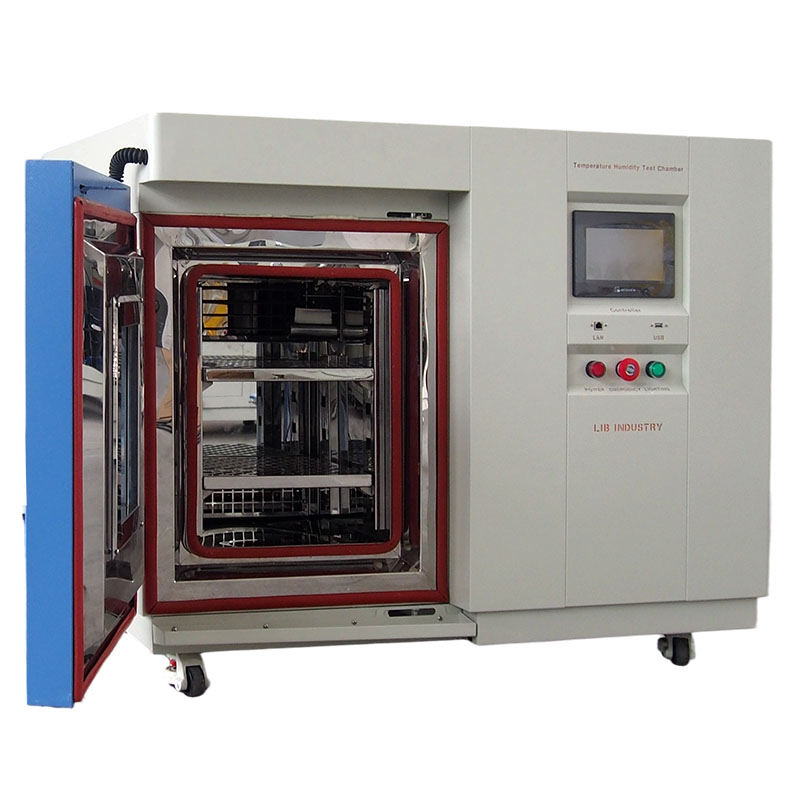 The easiest way to explain why stability matters is to look at a Benchtop Temperature humidity Test Chamber. This type of chamber is compact enough for labs with limited room, yet it still has to do the same core job as a larger system: create controlled, repeatable heat, cold, and humidity conditions around a test specimen.
A benchtop chamber is often chosen for electronics, sensors, small assemblies, batteries, materials, research tasks, and quality checks because it brings environmental testing close to the workbench. But small size does not automatically mean easy control. In a compact chamber, poor circulation can create hot corners, cold shelves, or humidity differences that push samples into uneven exposure. That is why better benchtop designs focus on forced airflow, programmable control, stable refrigeration, and continuous monitoring rather than size alone.
When selecting a benchtop temperature humidity test chamber, focus on control performance rather than just range. Key indicators include temperature fluctuation (how stable conditions remain over time) and temperature deviation (how close actual conditions are to the setpoint). Humidity deviation is equally important for moisture-sensitive tests. Heating and cooling rates affect test efficiency, while a reliable controller ensures repeatable programs. Also check airflow design and sensor accuracy, as these directly impact uniformity and data consistency in real testing conditions.

The LIB benchtop chamber is designed for laboratories that need reliable performance in limited space. It balances compact size with precise environmental control.
In real lab testing — especially for electronics or materials — even slight fluctuations can lead to inconsistent results. LIB’s chamber controls temperature fluctuation within ±0.5°C and humidity deviation within ±2.5% RH. This helps maintain repeatable and reliable testing conditions across cycles.
Compact 50L and 80L capacities for bench-level use
Temperature range from -20°C to +150°C
Humidity control from 20% to 98% RH
Stable fluctuation (±0.5°C) for consistent results
Programmable touchscreen controller
USB and Ethernet for data export and monitoring
Stainless steel interior for durability
Built-in safety protections for long-term operation
| Parameter | Typical Benchtop Chamber Value | Why It Matters |
|---|---|---|
| Capacity | 50L–80L, with compact formats starting around 30L | Fits small parts and bench-side testing |
| Temperature range | Low-temperature options to high heat, up to +150°C | Covers storage, soak, cycling, and durability work |
| Humidity range | 20%–98% RH | Supports damp heat, conditioning, and moisture exposure |
| Temperature fluctuation | ±0.5°C | Shows short-term control stability |
| Temperature deviation | ±2.0°C | Shows how close chamber conditions stay to the setpoint |
| Humidity deviation | ±2.5% RH | Helps judge wet-heat test reliability |
| Heating / cooling rate | 3°C/min heating, 1°C/min cooling | Affects throughput and cycling speed |
| Controller | Programmable touch screen | Supports repeatable recipes and easier operation |
| Connectivity | Ethernet and USB | Useful for logging, export, and remote monitoring |
| Build and safety | SUS304 interior, multiple protections | Better durability and safer long runs |
These specifications make the chamber suitable for daily lab testing, product validation, and controlled environmental simulations where stability and repeatability are critical.
Most buyers start with the temperature range. That is understandable, but it is not enough. A chamber that reaches the target once may still struggle with overshoot, slow recovery, or uneven distribution. A better buying checklist starts with fluctuation, deviation, airflow behavior, humidity stability, and controller quality. For benchtop work, it is also worth checking whether shelves, cable holes, observation windows, and connectivity come standard, because those details shape daily use more than glossy marketing claims do.
Ask what happens after the door opens. Ask how the chamber behaves at high humidity and low temperature. Ask whether the controller supports repeatable programming and export. Ask what protection system is built in. Ask how calibration, spare parts, and service are handled after delivery. These questions reveal more about real chamber quality than the headline range on the brochure.
Before the conclusion, it is worth placing the supplier in context.Xi’an LIB Environmental Simulation Industrypresents itself as a manufacturer and exporter of climatic test chambers. Its first exported test chamber dates back to 2009. Across its site, the company highlights standard and custom chamber production. It offers solution-oriented support. Product coverage spans climate, corrosion, weathering, IP, and special test categories. It uses a one-stop service model that includes delivery, installation, calibration, and spare parts. The company also states that it has sold to 42 countries. It operates through distributors in multiple markets. It offers a 3-year warranty with lifelong follow-up service. For buyers comparing suppliers, that combination of product range, custom capability, and after-sales depth is often as important as chamber specs themselves.
Temperature accuracy and steadiness are the soul of an environmental chamber. They decide whether test data can be trusted. A Benchtop Temperature Humidity Test Chamber makes that truth easy to see. It is compact. But the demands placed on it are serious. It needs stable air flow, reliable heating and cooling, accurate humidity control, clean monitoring, and safe long-duration operation. When those parts work together, the chamber becomes more than a box that changes climate. It becomes a dependable tool for product validation, faster lab decisions, and fewer repeated tests.
No single number tells the whole story. But temperature fluctuation and deviation are usually the first two to check. They show how steadily the chamber holds conditions. They also show how close it stays to the set point during real testing.
A wide range looks good on paper. But unstable control can still ruin the test. Steady performance is what makes repeated runs comparable. It keeps product decisions tied to the sample rather than chamber drift.
Yes. Benchtop chambers are commonly used for electronics, sensors, batteries, research, and laboratory work. They deliver controlled heat, cold, and humidity in a compact space close to the bench.
On the referenced LIB benchtop page, the temperature and humidity version is listed at 20% to 98% RH. Across other top benchtop product pages, similar humidity ranges appear often for small chamber configurations.
Ask about fluctuation, deviation, recovery after door opening, air flow design, controller programming, connectivity, calibration, spare parts, warranty, and after-sales support. Those answers usually reveal the real long-term value of the chamber.




 EN
EN


