

Lead Provider of Environmental Test Chamber
A smart device can look perfect at final inspection and still fail after a rough trip. A Bluetooth speaker may leave the factory with clean sound, then arrive with a loose battery lead. A wearable sensor may pass its app connection test, then show random signal drops after days of running, cycling, and charging.
Consumer electronics vibration testing helps smart hardware brands find weak solder joints, loose connectors, battery contact issues, rattling housings, and packaging-related damage before products reach customers. For teams selling routers, smart home devices, wearables, cameras, and IoT terminals, vibration testing is part of product reliability testing, shipping validation, and brand protection.
In consumer electronics, parts are packed into small spaces. A circuit board may sit close to a plastic housing. A display cable may bend around a hinge. A battery may be held by foam, screws, glue, or a molded frame. Nothing has much extra room.
That makes vibration risky. Damage can grow quietly after thousands of small movements. A connector starts to move. A solder joint gets a hairline crack. A screw loses preload. The product may still power on, but the next bump, charge cycle, or delivery route pushes it past the limit.
Electronics vibration testing gives engineering and quality teams a way to catch these hidden risks before mass production.
For many smart hardware brands, the first hard test happens after packaging. A product moves from the assembly line to a warehouse, then into cartons, pallets, trucks, air freight, sea containers, courier vans, and last-mile delivery bags. Each step adds random vibration, shock, compression, and temperature change.
A shipping vibration test should look beyond whether the outer box stays intact. The device inside also matters.
| Shipping condition | Possible product risk |
| Long truck transport | PCB fatigue, loose screws, battery contact wear |
| Air and sea freight | Package movement, connector stress, foam compression |
| Conveyor sorting | Repeated shock, display module stress |
| Last-mile delivery | Drops, rolling, vibration from vehicles |
Packaging can hide the damage. The box may look fine, while the USB port, camera module, speaker magnet, antenna, or battery tab has already moved. That is why consumer electronics vibration testing often combines packaged-product checks with unpackaged product inspection.
Shipping is only the beginning. Wearable devices move during running and cycling. Smart speakers create low-frequency vibration when bass output is high. Laptops and tablets sit in backpacks, cars, and trains. Smart locks, routers, handheld scanners, sensors, and outdoor IoT devices may work near motors, doors, tools, or moving equipment.
These vibration risks in electronic devices are small and repeated. A customer may say, “It only disconnects sometimes.” That complaint is hard to reproduce unless the test plan includes vibration, function monitoring, and post-test inspection.
PCB vibration testing is one of the most useful checks for smart hardware reliability testing. It targets the areas where electrical and mechanical design meet.
PCB solder joint vibration failure often appears around larger or heavier parts. Charging ports, shield cans, inductors, display connectors, and battery terminals can place extra stress on solder joints. The board may pass a basic power-on test, but vibration can reveal weak joints that open under movement.
Connector failure vibration test work is important for products with flat cables, antenna leads, USB ports, SIM trays, battery connectors, and board-to-board connections. The problem may be a short signal loss or random restart.
Small battery-powered products are also sensitive to contact pressure. A battery vibration test for electronics can show whether foam pads, brackets, springs, weld tabs, and cable routing keep the battery stable during transport and use.
Not every failure is electrical. Rattles, cracked clips, loose screws, buzzing speaker parts, and lens movement can also hurt user trust. A customer may return a product simply because it “feels cheap” after a few days.
There is no single vibration profile for every device. The right test depends on the product, market, customer requirement, and life cycle. Still, most electronics vibration testing plans include random, sine, and shock testing.
Random vibration testing for electronics is widely used to copy transport and mixed real-world movement. It is helpful for packaged products, handheld devices, PCB assemblies, and smart home devices shipped in large volumes.
A sinusoidal vibration test for electronics is useful when engineers need to find resonant points. If a part vibrates strongly at a certain frequency, that area may need more support or better fastening. Drop shock and vibration testing often works with vibration because a product may survive a single drop but fail after internal parts have loosened.
Real shipping and daily use rarely happen at room temperature. A smart camera may sit in a hot delivery van. A wearable may move from winter air into a warm gym. A router may work for years in a humid apartment. Temperature changes affect plastics, adhesives, foam pads, solder joints, and seals. Humidity can raise the risk of corrosion, leakage current, and poor contact.
That is why combined temperature humidity vibration testing is valuable for many consumer electronics. Separate tests can miss problems that only appear when stresses act together. A connector may stay tight at room temperature but loosen after heat softens nearby plastic. A battery pad may seem stable until humidity and vibration weaken the adhesive.
A temperature humidity vibration test chamber lets teams run closer-to-life tests without moving samples between machines.
A useful consumer electronics vibration testing plan starts with the product’s real journey, not with a copied lab schedule.
Will the product be tested packaged, unpackaged, or both?
Which parts are most likely to move: PCB, battery, connector, display, lens, speaker, antenna, or screws?
Should the product be powered during the test?
Which axes need testing: X, Y, Z, or all three?
What data should be logged during and after the test?
What counts as failure: no power, restart, signal drop, noise, crack, looseness, or cosmetic damage?
During the test, teams should monitor key functions where possible. A smart lock can be cycled after vibration. A wearable can log sensor output. A speaker can run an audio check. Good records make the reliability test report for electronics more useful for customers and internal review.
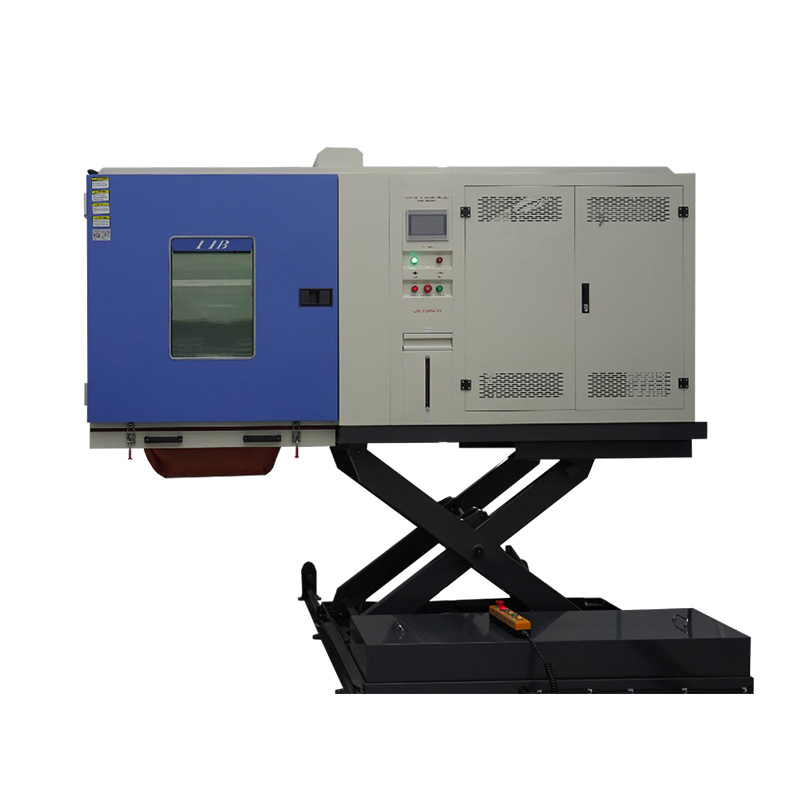
For smart hardware brands and test labs, a vibration test chamber should support repeatable testing, clear data records, and mixed environmental stress. LIB Vibration Test Chamber combines temperature, humidity, and electrodynamic vibration in one system, helping teams test products under conditions closer to shipping and daily use.
| Key item | Value for electronics testing |
| Temperature range | -50°C to +150°C for cold, heat, and thermal stress checks |
| Humidity range | 30% to 98% RH for damp storage and humid transport simulation |
| Vibration system | Built-in electrodynamic shaker for mechanical stress testing |
| Payload capacity | Up to 500 kg for larger samples, fixtures, or batch testing |
| Control and data | Programmable profiles with RS232/USB data export |
| Construction | SUS304 stainless steel interior for long service life |
| Test efficiency | Temperature, humidity, and vibration in one workflow |
For electronics reliability testing, this setup helps reduce sample handling and test gaps. A team can check PCB assemblies, packaged smart devices, battery-powered products, sensors, routers, smart speakers, handheld terminals, and other consumer electronics in a controlled test space.
Xi’an LIB Environmental Simulation Industry is a climatic and environmental test chambers supplier based in China. Since 2009, the company has worked in the design, production, sales, and service of environmental simulation equipment for global customers. Its product range covers temperature and humidity chambers, corrosion chambers, weathering testers, dust and rain test chambers, ozone test chambers, gas corrosion chambers, ovens, walk-in chambers, and related test solutions.
LIB serves electronics, automotive, battery, material, laboratory, and research customers. The company provides standard chambers and custom test solutions for different sample sizes, standards, and working conditions. Its service support includes specification selection, quotation support, transportation, installation, calibration, spare parts, training, warranty service, and follow-up technical help.
Testing vibration of consumer electronics is more than passing a laboratory test. It is finding the smallest of failures that translate into returns, bad reviews, warranties that cost money, and even delays of market launches due to feedback from customers.
A good test plan contains packaged as well as unpackaged test cases for movement in all three X, Y, Z directions, checks on the functions, a visual inspection after testing and adequate records of the test results. For higher risk smart hardware it is wise to test this in combined temperature humidity vibration tests, because single tests often miss failures that are found in combined tests.
In order to test and verify smart devices, PCB assemblies, batteries, connectors, displays as well as housings in the area of consumer electronics for their robustness against vibration, during transport as well as in normal use.
In order to test shipping vibrations packaged articles are typically subjected to random vibration tests. The packaged article and tested device are then inspected for such items as power being on, charging being connected, wireless connection being active, display being on, audio playing, battery contacts being clean and secured, all screws being tightened and any visible damage.
Testing a PCB for vibration may expose hidden defects of solder joint cracks, loose connectors, excessive movement of components and electrical intermittent faults which could not be found by normal function test.
View more product



 EN
EN


